Retour à la vue d'ensemble

Fastening systems: Small components, big impact
2026-03-25 | 

They are barely visible, yet so crucial for safety and efficiency on the track: fastening systems play a central role in load transfer and elasticity control. In this interview, Thomas Mayer, Vice President – R&D and Engineering Fastening Systems, provides insights into the complex world of fastening systems and shows why the interaction of components determines performance and service life.

Mr. Mayer, what is a fastening system — and what is its key function in the track?

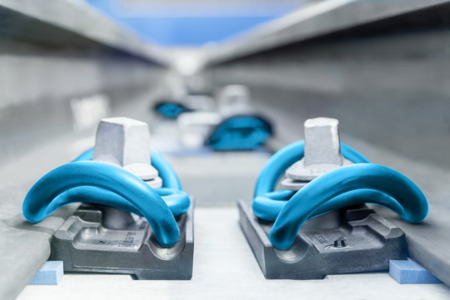
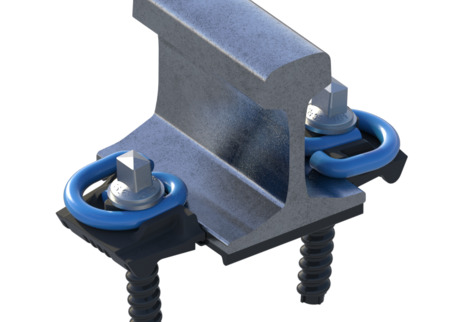
Fastening systems comprise everything between the rail and the sleeper. This includes highly safety-relevant components such as the tension clamp, which applies a permanent force to the rail, and plastic components such as the angle guide plate, which transfers lateral loads. The interlayer, as an elastic element, has a major influence on the overall system  on elasticity, load distribution, and vibrations in the track. The main task of the fastening system is to reliably transfer the forces from train operation from the rail to the subgrade via the sleeper. Reliability, fail-safety, and wear resistance are crucial here. 

How important is the interaction of individual components within the fastening system?

Clamping clips and interlayers are separate components, but they must be precisely matched to each other. The interlayer defines the movement of the rail relative to the sleeper, and the tension clamp must be able to withstand this movement elastically without breaking. The challenge lies in combining the fatigue strength of the tension clamp with the elasticity of the interlayer. Different customer requirements mean different elasticities — and thus constantly new dimensioning and optimization work. 

What are the biggest challenges facing modern fastening systems?

There is a conflict of interest between load transfer and noise reduction. Good load distribution benefits from high elasticity, while noise reduction often requires stiffer systems. The aim here is to find the optimal compromise —particularly relevant in residential areas. 

Added to this are signs of wear, which are particularly an issue with plastic components such as the intermediate layer and the angle guide plate. It is precisely with these components that we are striving to reduce wear on the rail in order to increase service life. This involves everything from wider contact surfaces to new materials.

Another challenge is the extreme diversity of systemsVirtually every country has its own fastening systems and components, in some cases for historical reasons. This diversity increases complexity along the entire value chain. 

What are the advantages of voestalpine Railway Systems' fastening systems, and how do they increase service life and cost-effectiveness?

One major advantage is that the components are coordinated with each other. We always view the fastening system as part of an overall system and ask ourselves: Where is the weakest link? Is it the tension clamp or rather the interlayer? As a system provider, we have the opportunity to coordinate and optimize the service life and load-bearing capacity of the individual components not in isolation, but in combination with each other. The robustness of individual components in particular has an enormous economic impact. A single clamp breakage does not usually pose an immediate safety risk because maintenance processes are in place. However, replacement itself is costly. Every maintenance measure that is avoided increases availability and reduces costs. 

What role does logistics play in fastening systems?

Logistics is a key aspect. It's not just about technical performance on the track, but also about how efficiently a system gets to the construction site. That is why we offer pre-assembly. This means that the complete fastening system is already assembled on the sleeper at the factory and delivered to the construction site ready for use. The advantage of this is that no components are lost and nothing has to be reassembled on site. Pre-assembly has clear logistical advantages for customers, as the assembly process can be completed much more easily and quickly. 

What innovations can we expect in the future with regard to fastening systems?

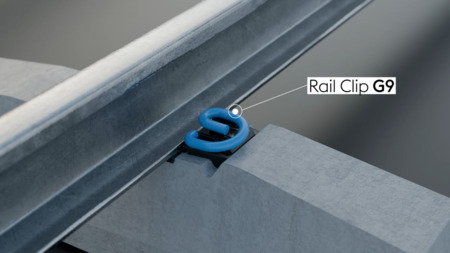
One key project is the G9 clip. We have implemented a completely new idea here and developed a more robust clamping clip that can be used universally thanks to its simplicity. Its compactness within the system also offers more possibilities than a conventional standard fastener. We also want to focus on modularity here. This means using components that are as similar as possible and adapting the system flexibly to different requirements. In problem areas — for example, in tight curves with high loads — we can respond specifically with a double fastening on the sleeper. In sections of track with lower loads, we tend to build more modularly. However, this only works in conjunction with the sleeper or the overall system.

About the expert

Thomas Mayer gained his first experience at voestalpine Railway Systems as a working student and through various internships. After working in production, assembly, and logistics, he now has a comprehensive understanding of what is important in the development of modern fastening systems as head of R&D and Engineering Fastening Systems. For Thomas Mayer, the opportunity to positively influence the railway system with small, inconspicuous components is what makes his field of work so fascinating.