Voltar à perspetiva geral

Life cycle and circular economy: Rethinking sustainability
2026-03-30 | 

Compared to road transport, rail transport is considered safer and more eco-friendly. However, with the increasing shift to e-mobility, a new challenge is emergingSecuring and further expanding the ecological advantage of rail transport in the long term. What role do life cycle thinking and circular economy play in this? Christian Aichberger, sustainability expert at voestalpine Railway Systems, provides insights into how these issues are viewed holistically and translated into concrete solutions. 
Mr. Aichberger, sustainability is often reduced to CO₂ reduction or energy savings. How do you understand sustainability in the context of voestalpine Railway Systems?

It's true that many people first think of energy conservation or CO reduction when they hear the term sustainability. But it's actually a very broad topic. In the system approach of voestalpine Railway Systems, sustainability is the sum of various components. For us, sustainability has three levels: ecological, social, and economic. So, we are not only talking about environmental aspects, but also about social responsibility and economic efficiency. After all, if solutions are not economically viable, for example, this also creates problems. 

What does the system concept at voestalpine Railway Systems mean in concrete terms for track systems?

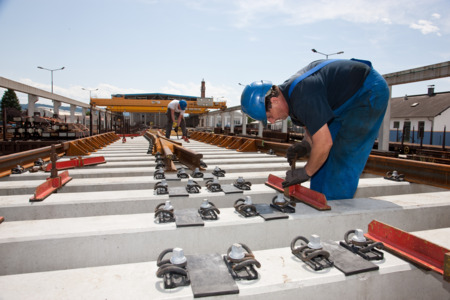
As passengers, we usually only see the rails. But a track system consists of many different components, such as sleepers, fastening systems, and a substructure. These components interact and influence each other. The system concept is: We don't just produce individual components and deliver them. We look at the entire system and first ask ourselves: What will the product be used for? Where will it be used? How can we optimize the system? Only then do we consider individual production steps. Another important factor for us is our focus on the customer and how we can best support them in real-world applications. 

What advantages does this system approach offer rail operators?

When the rail system is operating optimally, it becomes more attractive for passenger and freight transport. There are also some indirect effects on the system as a whole. There are fewer speed restrictions due to construction sites. This means that the train has to brake and accelerate less, which in turn reduces energy consumption and the associated CO2 emissions. Reduced maintenance and repair work has similar effects. By making the system more efficient and reliable, we increase capacity and sustainability  even before we talk about our efforts in our own production processes. 

Why is the life cycle approach so crucial in the railway industry?

Life Cycle Costs (LCC) play a central role in the railway sector. The aim is to optimize costs over the entire life cycle. At the same time, we consider the environmental impact using Life Cycle Assessment (LCA). This method evaluates the environmental performance of products and services along the entire value chain. Specifically, we look at: raw materials, energy use, our own production processes, resource requirements, transport & installation, the usage phase, and end of life. The usage phase is particularly important. If a product lasts twice as long, emissions can be practically halved over the period because less new production is necessary. 

It is important to remember that a product with lower emissions is not automatically more sustainable to manufacture. If it fails prematurely, new production and disposal costs arise  including construction sites and downtime. And: we think about the end of life as early as the product design stage. What materials do we use? What can be reused? This also optimizes the circular economy. 

How does voestalpine Railway Systems implement re-use in practice?

A prime example of re-use is Weichenwerk Wörth in Lower Austria, a joint venture of voestalpine Railway Systems and ÖBBThere, old turnouts from the main network are removed, processed, tested, and components that are still usable are reused in secondary lines with lower loads. Here, we have the system concept as well. I have a rail network with areas of higher and lower traffic. Especially in less polluted areas, the targeted re-use of suitable old turnouts instead of newly produced ones is a good option. 

What is the significance of circular economy for sustainable track systems?

There are two key aspects to circular economy. The first is the ecological aspect. Circular economy reduces the need for new materials. Steel, for example, can be remelted. This saves us the CO2-intensive manufacturing process for pig iron, which must first be extracted from iron ore using coke. 

The second is the strategic aspect. Europe is not exactly a region rich in raw materials. Except for the Erzberg in Styria, most ores are sourced from other continents. The more new material we produce, the more raw materials we need. This makes us more dependent on procurement. A certain proportion of new material will continue to be necessary in the future for supply reasons. At the same time, however, well-functioning cycles will also be crucial in order to enhance ecological benefits, reduce strategic risks, and create a resilient raw material base for sustainable track systems. 

About the expert

Christian Aichberger has been part of voestalpine Railway Systems since 2021. He is responsible for product sustainability and life cycle analyses in the sustainability department at voestalpine Railway Systems. He is particularly enthusiastic about the interdisciplinary collaboration within the team and the opportunity to consistently work on topics that are relevant for the future.